
Introduction
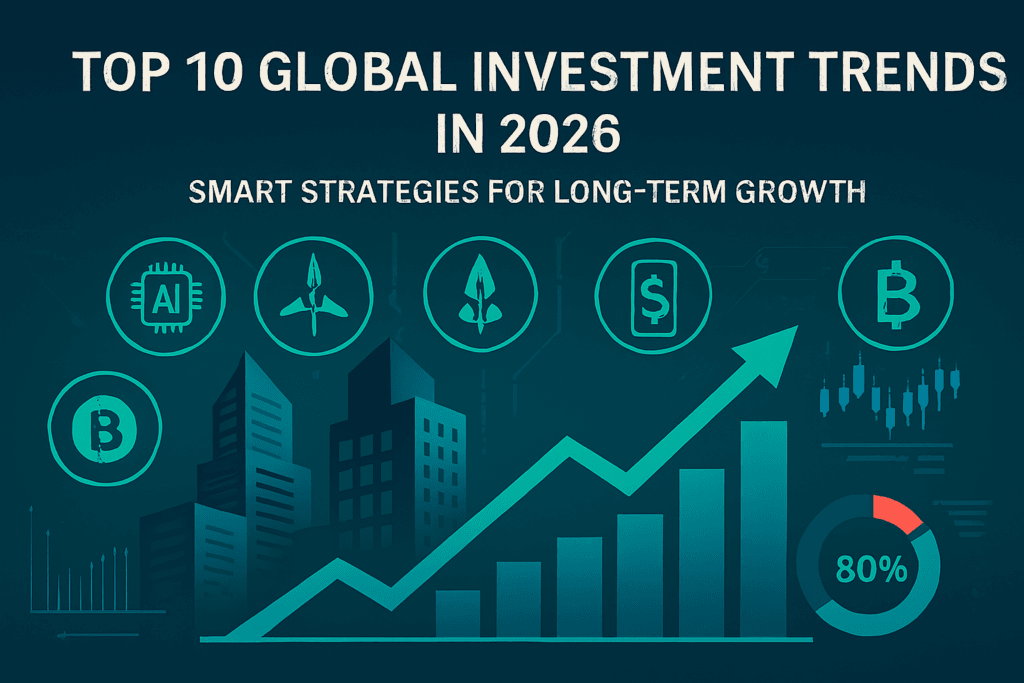
The Top 10 Global Investment Trends in 2026 are reshaping the global financial landscape, offering both opportunities and risks for investors in the USA, UK, Canada, and Australia. While daily market swings capture headlines, it is the global investment trends 2026 that define long‑term value creation. These megatrends — artificial intelligence, blockchain, private credit, energy transition, and digital infrastructure — are driving capital flows and influencing how portfolios are built for resilience.
Artificial intelligence is emerging as a capital engine, with corporations committing billions to data centers, chip innovation, and automation. Blockchain is transforming transparency in finance, enabling secure cross‑border transactions and smart contracts. Private credit is rising as a powerful alternative to traditional banking, while energy transition investments are accelerating with renewable infrastructure and green technologies promising resilience beyond hydrocarbons.
Global reports confirm that investment trends in 2026 are structural, not cyclical. According to J.P. Morgan’s 2026 Outlook, AI and deregulation in financials are expected to underpin growth, even as inflation and debt remain persistent challenges. Columbia Threadneedle highlights resilience but warns of lingering risks, making diversification essential. Meanwhile, the Global mobile Suppliers Association (GSA) notes that 647 operators across 191 countries are actively investing in 5G, expanding digital infrastructure worldwide.
For investors targeting high‑CPM regions, the Top 10 Global Investment Trends in 2026 represent a roadmap to growth. By aligning with these megatrends — AI, blockchain, private credit, energy transition, 5G, and geopolitical diversification — portfolios can capture opportunities while navigating uncertainty. This guide explores each trend in detail, showing how global forces are reshaping investment strategies for the future.
2. Artificial Intelligence as a Capital Engine
How Artificial Intelligence is Steering Global Investment Trends in 2026
Artificial intelligence is at the core of the Top 10 Global Investment Trends in 2026, reshaping industries from finance to manufacturing. Corporations are committing billions annually to AI infrastructure — data centers, chip innovation, and automation — making AI investment opportunities 2026 one of the strongest growth drivers worldwide. This surge is not only about technology but about productivity gains, supply chain efficiency, and long‑term capital deployment.
Corporate Spending and Market Impact
Global corporates are expected to allocate tens of billions toward AI‑driven projects, including machine learning platforms, predictive analytics, and generative AI applications. These investments are influencing supply chains for semiconductors, specialist metals, and cloud infrastructure. For investors, this means opportunities in both direct AI companies and secondary markets that benefit from AI adoption.
AI in Personal Finance and Fintech
The rise of AI in personal finance is already visible in budgeting apps, robo‑advisors, and digital wallets. As highlighted in Fintech Innovations 2025: Personal Finance, AI is transforming how individuals save, invest, and manage risk. By 2026, these innovations are expected to scale globally, offering investors exposure to fintech firms that integrate AI into everyday financial tools.
External Perspective
According to J.P. Morgan’s 2026 Outlook, AI is not just a technological trend but a capital deployment engine. The report emphasizes that corporate spending on AI will underpin global growth, even as inflation and debt remain persistent challenges. This aligns with broader global investment trends 2026, where AI is positioned as a structural driver of long‑term value creation.
3. Blockchain Finance & Transparency
How Blockchain is Shaping Global Investment Trends in 2026

Among the Top 10 Global Investment Trends in 2026, blockchain stands out as a transformative force in finance. The technology is enabling secure, transparent, and efficient cross‑border transactions, making blockchain finance trends 2026 a critical area for investors. With smart contracts and decentralized ledgers, blockchain reduces reliance on intermediaries, lowers transaction costs, and enhances trust in global markets.
Applications in Payments and Savings
Blockchain adoption is accelerating in digital wallets, savings apps, and cross‑border remittances. As highlighted in Top 10 Mobile Wallets in USA 2026, blockchain integration ensures faster settlements and improved security. For investors, this means exposure not only to cryptocurrency markets but also to fintech firms leveraging blockchain for mainstream financial services.
Transparency and Risk Management
One of the most powerful aspects of blockchain is its ability to create immutable records. This transparency is reshaping compliance, auditing, and fraud prevention. Investors in USA, UK, Canada, and Australia are increasingly drawn to firms that use blockchain to strengthen governance and reduce systemic risk.
External Perspective
The World Economic Forum emphasizes that blockchain is no longer a niche technology but a structural driver of financial innovation. According to their 2026 outlook, blockchain adoption in finance will expand beyond cryptocurrencies into mainstream banking, asset management, and global trade. This aligns with broader global investment trends 2026, where transparency and efficiency are essential for long‑term growth.
4. Private Credit Growth
Private Credit Leading Global Investment Trends 2026
Within the Top 10 Global Investment Trends in 2026, private credit has emerged as one of the fastest‑growing asset classes. As traditional banks tighten lending due to regulatory pressures, private credit growth 2026 is filling the gap by offering flexible financing solutions to mid‑sized companies and institutional borrowers. This shift is creating new opportunities for investors seeking higher yields and diversification.
Why Private Credit Growth Matters
Private credit growth provides investors with access to direct lending, mezzanine financing, and distressed debt strategies. In high‑CPM regions such as the USA, UK, Canada, and Australia, private credit markets are expanding rapidly, offering returns that often outperform traditional fixed‑income assets. For investors, this trend represents a chance to diversify portfolios while capturing growth in sectors underserved by conventional banks.
Linking to Passive Income Strategies
Private credit growth is closely tied to passive income generation. As highlighted in Best Passive Income Ideas for 2025, alternative lending platforms and private credit funds are becoming mainstream tools for investors seeking steady cash flow. By 2026, these strategies are expected to scale further, making private credit growth a cornerstone of modern passive income portfolios.
External Perspective
According to Bloomberg’s 2026 Private Credit Outlook, the sector is projected to surpass $2 trillion globally, driven by institutional demand and regulatory shifts. Analysts emphasize that private credit is no longer a niche market but a structural component of global finance. This aligns with broader global investment trends 2026, where alternative lending is reshaping capital markets and investor strategies.
5. Energy Transition Investments
How the Energy Transition is Driving Global Investment Trends in 2026
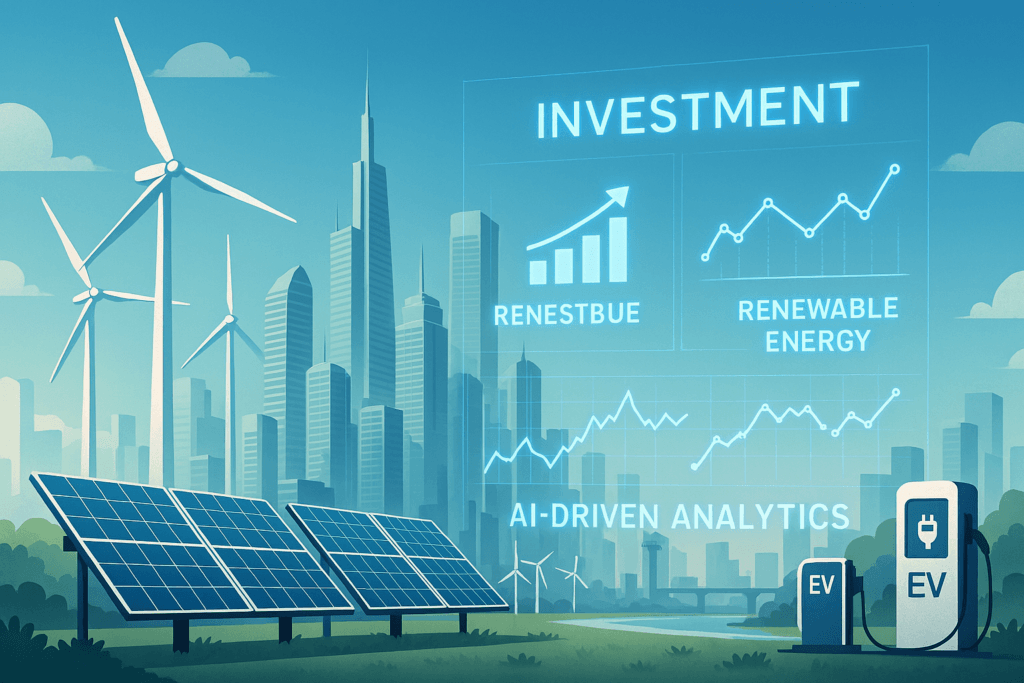
Among the Top 10 Global Investment Trends in 2026, energy transition stands out as a structural driver of capital flows. Governments and corporations are accelerating investments in renewable energy, electric vehicles, and green infrastructure. This surge in energy transition investments 2026 reflects both environmental commitments and the pursuit of long‑term resilience beyond hydrocarbons.
Renewable Infrastructure and Green Technologies
Wind, solar, and battery storage projects are attracting billions in new capital. Investors in USA, UK, Canada, and Australia are positioning portfolios to capture growth from clean energy adoption. Green hydrogen and EV charging networks are also expanding rapidly, offering diversified opportunities across multiple sectors.
Linking to AI-Powered Finance
Energy transition is closely tied to fintech adoption. As highlighted in Best AI-Powered Savings Apps in USA 2026, AI is helping individuals and institutions optimize savings and investments toward sustainable assets. By 2026, AI‑driven platforms are expected to guide investors toward renewable projects, making sustainability a mainstream financial strategy.
External Perspective
The International Energy Agency (IEA) projects that global clean energy investments will surpass $2 trillion annually by 2026. Their outlook emphasizes that renewable infrastructure is not only essential for climate goals but also a cornerstone of economic growth. This aligns with broader global investment trends 2026, where energy transition is reshaping capital markets and investor priorities.
6. 5G & Digital Infrastructure Expansion
5G as a Global Investment Trend in 2026
Within the Top 10 Global Investment Trends in 2026, the rollout of 5G networks is one of the most significant drivers of capital flows. Telecom operators across 191 countries are investing heavily in infrastructure, making digital connectivity a cornerstone of economic growth. For investors, 5G represents opportunities in telecom, IoT, smart cities, and cloud services.
Digital Infrastructure and Smart Cities
The expansion of 5G is enabling smart city projects, autonomous vehicles, and advanced IoT applications. These developments are reshaping urban planning and creating new investment opportunities in construction, energy, and technology sectors. Investors in USA, UK, Canada, and Australia are particularly well‑positioned to benefit from this wave of infrastructure spending.
Linking to Fintech and Wallets
5G adoption is also accelerating fintech innovation. As highlighted in Top Digital Wallets in USA 2025, faster connectivity enhances mobile payment systems, digital wallets, and AI‑powered apps. By 2026, seamless 5G integration will allow financial platforms to deliver real‑time services, strengthening both consumer adoption and investor confidence.
Investor Outlook
For investors, 5G is not just about telecom stocks but about the broader ecosystem. Cloud computing, cybersecurity, and edge computing firms are all beneficiaries of this infrastructure expansion. As part of the global investment trends 2026, 5G represents a structural opportunity to capture growth across multiple industries.
7. Geopolitical Shifts & Diversification
Controlled Disorder in Global Investment Trends 2026
One of the defining features of the Top 10 Global Investment Trends in 2026 is the rise of geopolitical uncertainty. Inflation, sovereign debt, and shifting power dynamics are creating what analysts call “controlled disorder.” For investors, this means that diversification is no longer optional but essential.
Inflation, Debt, and Market Volatility
Persistent inflation and rising debt levels are reshaping capital markets. Investors in USA, UK, Canada, and Australia must prepare for volatility across equities, bonds, and commodities. Diversification across regions and asset classes is critical to mitigate risks while capturing growth opportunities.
Diversification Beyond U.S. Mega Caps
While U.S. mega cap stocks remain dominant, the global investment trends 2026 highlight the need to look beyond them. Emerging markets, alternative assets, and regional diversification are becoming key strategies. This shift ensures portfolios are resilient against geopolitical shocks and sector‑specific downturns.
Linking to Stock Market Basics
For beginners, diversification is a foundational principle of investing. As explained in Beginners Guide to Stock Market Investing 2025, spreading investments across different sectors and geographies reduces risk and enhances long‑term returns. By 2026, this principle is more relevant than ever, given the global uncertainties shaping financial markets.
8. Regional Perspectives
USA: AI and Private Credit Leadership
In the USA, the Top 10 Global Investment Trends in 2026 are led by artificial intelligence and private credit. Corporations are investing billions in AI infrastructure, while private credit markets are expanding rapidly as alternatives to traditional banking. For investors, this dual focus creates opportunities in both technology and alternative lending.
- Internal link: Fintech Innovations 2025: Personal Finance
UK: Regulatory Strength in Fintech
The UK continues to position itself as a global fintech hub. Strong regulatory frameworks are enabling blockchain adoption and AI‑powered financial services. Investors benefit from a stable environment that encourages innovation while maintaining transparency.
- Internal link: Top 10 Mobile Wallets in USA 2026
Canada: Energy Transition Leadership
Canada is at the forefront of energy transition investments 2026, with significant capital flowing into renewable energy, EV infrastructure, and green hydrogen projects. Investors targeting sustainability will find Canada a key market for long‑term growth.
- Internal link: Best AI-Powered Savings Apps in USA 2026
Australia: Blockchain Adoption and Diversification
Australia is embracing blockchain for payments, savings, and cross‑border transactions. At the same time, diversification strategies are gaining traction as investors seek resilience against global volatility. Blockchain adoption positions Australia as a regional leader in financial innovation.
- Internal link: Best Passive Income Ideas for 2025
9. Risks & Challenges
Risks in Global Investment Trends 2026
While the Top 10 Global Investment Trends in 2026 present exciting opportunities, they also come with significant risks. Inflationary pressures, rising debt levels, and geopolitical tensions are reshaping how investors approach capital allocation. These risks highlight the importance of diversification and careful portfolio management.
Inflation and Debt Concerns
Persistent inflation remains a challenge across developed and emerging markets. Rising sovereign debt levels in the USA, UK, Canada, and Australia are creating uncertainty in bond markets and increasing volatility in equities. For investors, this means that even strong global investment trends 2026 must be approached with caution, balancing growth opportunities against macroeconomic risks.
Adoption Barriers in Emerging Markets
While AI, blockchain, and energy transition investments are accelerating in high‑CPM regions, adoption in emerging markets is slower due to infrastructure gaps and regulatory hurdles. This uneven pace of adoption creates risks for global portfolios, especially those heavily exposed to developing economies.
Linking to Personal Finance Basics
For individual investors, managing risks begins with strong financial foundations. As explained in Personal Finance Basics: How to Build Wealth in 20s, building wealth requires balancing opportunity with caution. By applying these principles to the Top 10 Global Investment Trends in 2026, investors can navigate uncertainty while positioning portfolios for long‑term growth.
Global Investment Trends 2026: Building Smarter Portfolios
The Global Investment Trends 2026 highlight how investors must adapt to rapid changes in technology, sustainability, and geopolitics. Artificial intelligence is reshaping productivity, blockchain is redefining transparency, and private credit is offering alternatives to traditional banking. These shifts are not isolated; they form a connected ecosystem of opportunities that investors can leverage for long‑term growth.
Energy transition is another defining force within the Global Investment Trends 2026, as renewable power, EV infrastructure, and green hydrogen attract record levels of capital. At the same time, 5G and digital infrastructure are enabling smart cities, fintech innovation, and new consumer behaviors. For investors, these developments represent both growth potential and risk management challenges.
Geopolitical diversification also plays a critical role in the Global Investment Trends 2026. With rising tensions and shifting alliances, portfolios must be balanced across regions to reduce exposure to volatility. Countries like the USA, UK, Canada, and Australia are leading these changes, offering high‑CPM opportunities for global investors.
Ultimately, the Global Investment Trends 2026 are about resilience. By combining AI, blockchain, private credit, energy transition, and diversification strategies, investors can build smarter portfolios that thrive in uncertain times.
10. Conclusion
The Top 10 Global Investment Trends in 2026 highlight how structural forces — artificial intelligence, blockchain, private credit, energy transition, 5G, and geopolitical diversification — are reshaping global capital markets. For investors in the USA, UK, Canada, and Australia, these trends represent both opportunity and risk. Aligning portfolios with these megatrends ensures resilience, growth, and long‑term value creation.
Artificial intelligence is driving productivity and corporate spending, blockchain is transforming transparency in finance, private credit is expanding as an alternative to traditional banking, and energy transition investments are accelerating toward a sustainable future with many AI investment opportunities. Meanwhile, 5G and digital infrastructure are enabling smart cities and fintech innovation, while geopolitical shifts demand diversification beyond U.S. mega caps.
For readers seeking deeper strategies, explore related posts such as Best Passive Income Ideas for 2025, Fintech Innovations 2025: Personal Finance, and How to Invest in Stocks. These resources provide practical insights into building wealth, managing risk, and leveraging technology in personal finance.
By understanding and acting on the top 10 global investment trends in 2026, investors can position themselves at the forefront of change, capturing opportunities while navigating uncertainty. The future of finance is being written today — and those who adapt will thrive in the decade ahead.


Pingback: Best AI Crypto Portfolio Apps in USA 2026 for Beginners - RevoValue
Pingback: iRobot Bankruptcy 2025: Resilient Roomba Future and Smart Home Finance Outlook 2026 - RevoValue